
usIn my 12+ years inspecting homes in Central Kentucky, I’ve learned that if I could only check one thing on a house, I’d follow the water. Where does the rain go when it hits the roof? Where does it go when it hits the ground? The answers to those two questions explain a surprising number of the things I write up in a report—damp crawlspaces, stained basement walls, sticking doors, and that musty smell nobody can quite place.
Fall is the perfect time to think about it. The leaves are coming down, gutters are filling up, and our wetter months are right around the corner. Here’s what I look for during an inspection, what it means, and what you can do about it before winter.
Why Water Is Usually the Culprit
Water is patient. It doesn’t have to do much damage in a single storm—it just has to keep showing up in the same place, year after year. A lot of Central Kentucky sits on clay-heavy soil that holds onto moisture, so when roof runoff gets dumped right next to the foundation, it tends to stick around. Eventually it finds its way into the crawlspace or basement.
That’s why so many of my conversations start in one place and end up in another:
Me: “See this staining on the crawlspace wall? Let’s step outside for a second.”
Buyer: “Outside? I thought the problem was down here.”
Me: “The symptom is down here. The cause is usually right outside, at the end of that downspout.”
More often than not, the fix isn’t dramatic. It’s gutters, downspouts, and the slope of the dirt around the house.
Gutters and Downspouts: Small Parts, Big Job
A roof sheds a lot of water, and the gutter system’s whole job is to collect it and carry it away from the house. When it doesn’t, the water goes exactly where you don’t want it. Here’s what I commonly see:
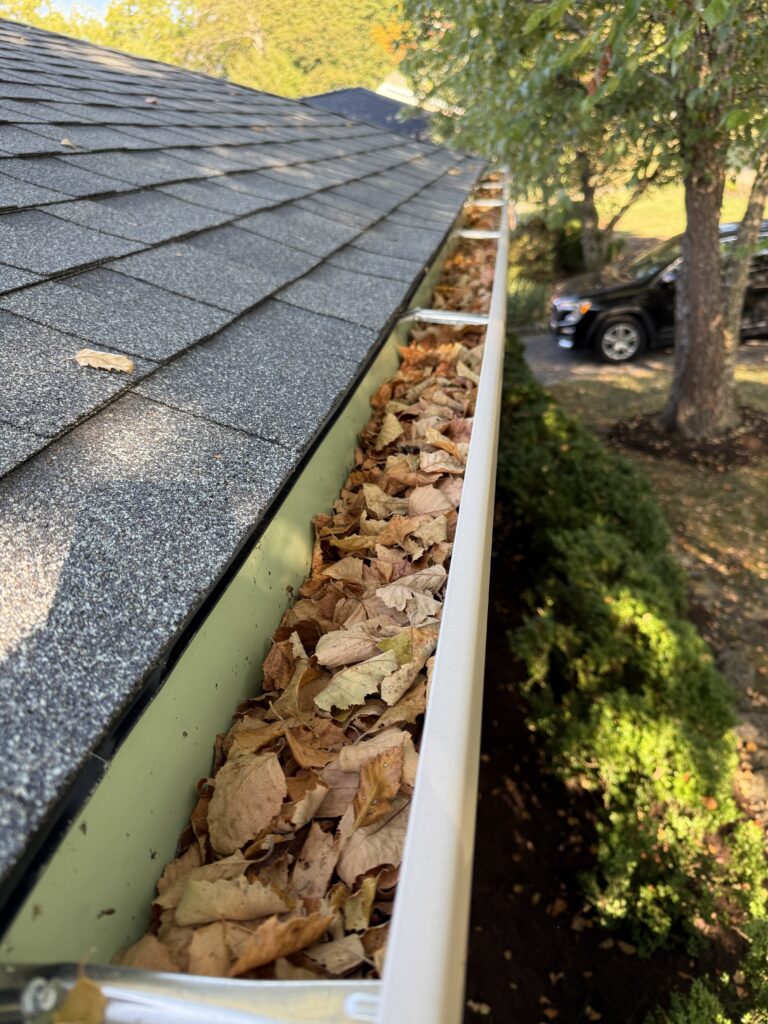
- Gutters clogged with leaves that overflow at the corners and pour water straight down along the foundation.
- Downspouts that end right beside the house with no extension, or extensions that got knocked off by the lawn mower and never put back.
- Gutters sagging, pulling away from the fascia, or leaking at the seams.
- Downspouts tied into underground drain lines. These can work well, but I can’t see inside a buried pipe, so evaluating underground drainage is beyond what a home inspection covers. If there are signs of trouble—like water backing up at the downspout—I’ll recommend having the line scoped by a qualified contractor.
The simple goal: get roof water several feet away from the foundation, and make sure it keeps flowing away once it lands.
Grading: Which Way Does the Ground Slope?
“Grading” is just a fancy word for the slope of the ground around your house. Ideally, it slopes away from the foundation so rainwater drains off toward the yard. Over the years, though, that slope has a way of reversing itself. Soil settles along the foundation, flower beds and mulch get built up higher and higher, and patios or sidewalks settle so they tilt back toward the house.
During a home inspection, I walk the exterior and note areas where the grading appears to slope toward the house or where soil and mulch are piled up against the siding. One of the best (and cheapest) inspections you can do yourself is to grab an umbrella and walk around your house during a good steady rain. Watch where the water goes. It’ll tell you a lot.
What It Looks Like Inside: Crawlspaces and Basements
When water management isn’t working, the crawlspace or basement is usually where the evidence shows up. When the crawlspace is accessible and safe to enter, I go in and take a look. Some of the things that catch my eye:
- Standing water or saturated soil
- White, chalky deposits on block or concrete walls (that’s efflorescence—minerals left behind as water moves through masonry)
- Water staining, rusty fasteners, or rust on ductwork and equipment
- Wet, sagging, or fallen insulation
- A missing or torn vapor barrier
- Musty odors, wood decay, or visible mold-like growth
One honest limitation: a dry crawlspace on inspection day doesn’t guarantee it stays dry. If we’ve had a few weeks without rain, a space that floods every spring can look perfectly fine. That’s why I pay attention to the clues water leaves behind, not just whether it’s wet that day.
If I find evidence of moisture intrusion, the report will say so and typically recommend evaluation by a qualified drainage or waterproofing contractor. If I see cracks or signs of foundation movement, I’ll recommend a structural engineer. And if you’re concerned about air quality, mold testing is available as an add-on to your home inspection, with lab results back in 2–3 business days.
Your Fall Water Checklist
Whether you just bought a home or you’ve lived there for 30 years, a little attention this time of year goes a long way:
- Clean your gutters once most of the leaves have fallen—and consider a second cleaning if you have a lot of trees.
- Check every downspout and make sure the extensions are attached and pointed away from the house.
- Walk the perimeter in the rain and look for puddles near the foundation.
- Pull mulch and soil back so the ground slopes away and stays below the siding.
- Peek into the crawlspace with a flashlight and look for standing water, a torn vapor barrier, or fallen insulation.
- Test your sump pump, if you have one, before the wet season.
- Call in the pros for repairs—a gutter contractor, a drainage or waterproofing contractor, or a structural engineer if you’re seeing cracks or movement.
Buying or Selling This Fall?
If you’re buying, fall is a great time to see how a house handles water. If we’re walking the house together, ask me to point out anything related to drainage, and read those comments carefully when your report arrives. My home inspection reports are delivered within 24 hours, so you’ll have time to ask questions and talk with your Realtor about next steps.
If you’re selling, drainage issues are some of the easiest things to fix ahead of time and some of the most unsettling things for a buyer to discover. A pre-listing inspection gives you the chance to clean things up on your schedule instead of in the middle of a negotiation.
Either way, you don’t have to figure it out alone. Follow the water, and you’ll usually find the answer.
Ready to schedule? Request a quote or book your inspection online, or give me a call at 859-227-1780. I’d be glad to help you get to know your home—wherever you are in Lexington and Central Kentucky.

Kari Cheek has been a licensed Home Inspector in the great state of Kentucky since 2014.
Need Inspection Services in Central Kentucky? Schedule your appointment today!
Kari Cheek (KY HI #103786)
Rosie Home Inspections
(859) 227-1780